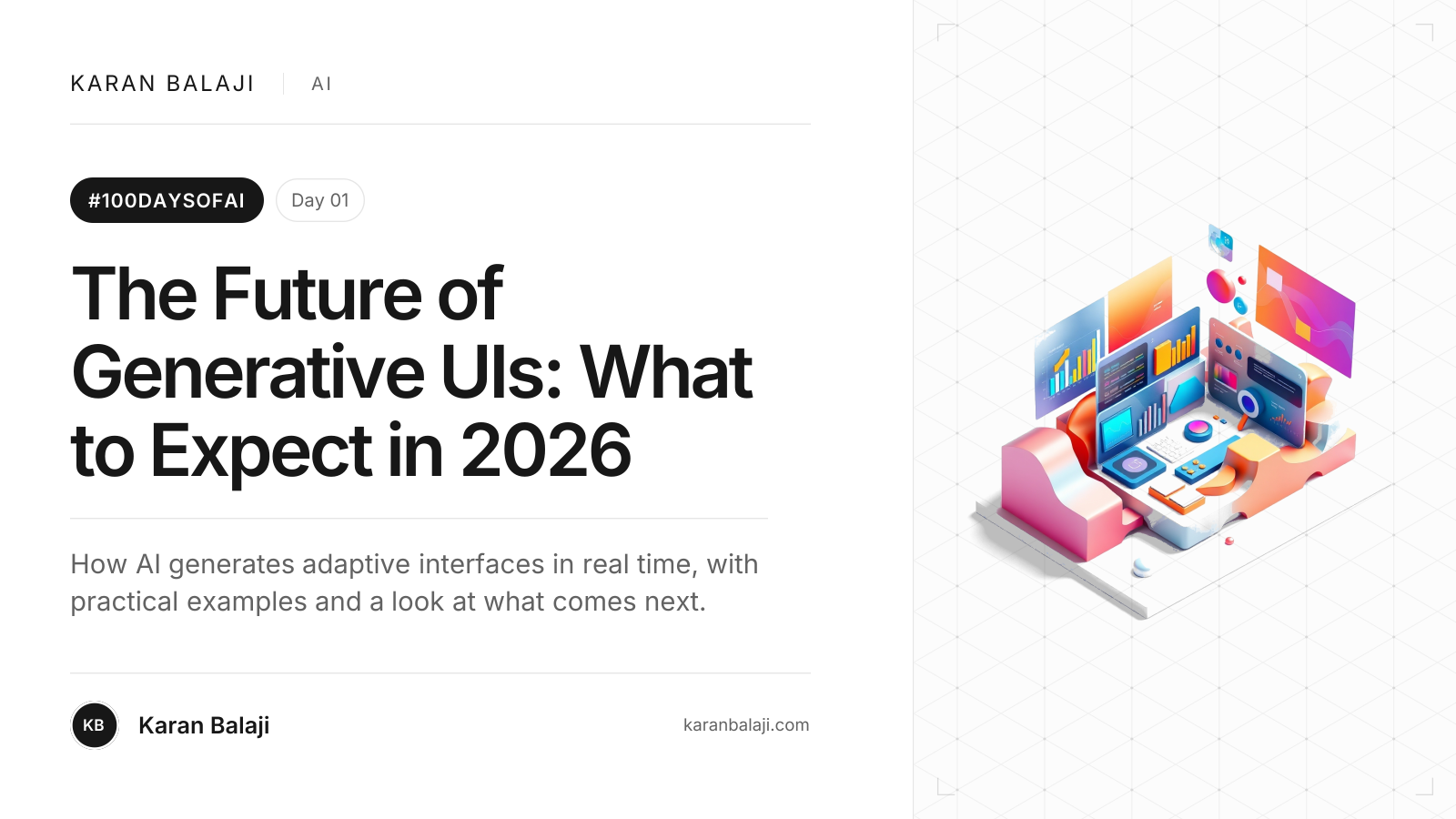
Day 1/100: The Future of Generative UIs: What to Expect in 2026
How AI generates adaptive interfaces in real time, with practical examples and a look at what comes next.
Intro to Generative Ui’s
Welcome to Day 1 of the #100DaysOfAi series! On this December 21, 2025, we're kicking off with one of the most exciting shifts in AI: Generative User Interfaces (Generative UIs). As 2025 draws to a close, we've seen massive leaps with Google's Gemini 3 rollout and emerging standards like the Model Context Protocol's UI extensions. This sets the stage for an explosive 2026 where AI doesn't just respond with text but builds entire interactive experiences on the fly. Let's dive into the current reality and what's coming next.
What: Understanding Generative UIs
Generative UIs mark a fundamental evolution where large language models (LLMs) generate not only content but complete, interactive user interfaces tailored to a user's prompt or context. Traditional UIs are static, predefined layouts coded by developers. In contrast, Generative UIs are dynamic: AI analyzes intent, fetches data via tools, and synthesizes custom elements like buttons, charts, simulations, or full apps in real time.

This capability exploded in late 2025 with Google's Gemini 3, which powers "Dynamic View" in the Gemini app and AI Mode in Search. For any query, Gemini 3 creates bespoke interfaces, such as interactive loan calculators or physics simulations. Frameworks like Vercel's AI SDK enable this by linking tool calls (e.g., data retrieval) to React components for rendering. Emerging protocols, including extensions to the Model Context Protocol (MCP), allow secure embedding of rich UIs via iframes, supporting bidirectional agent-user interactions.
MCP UI APPS Example:
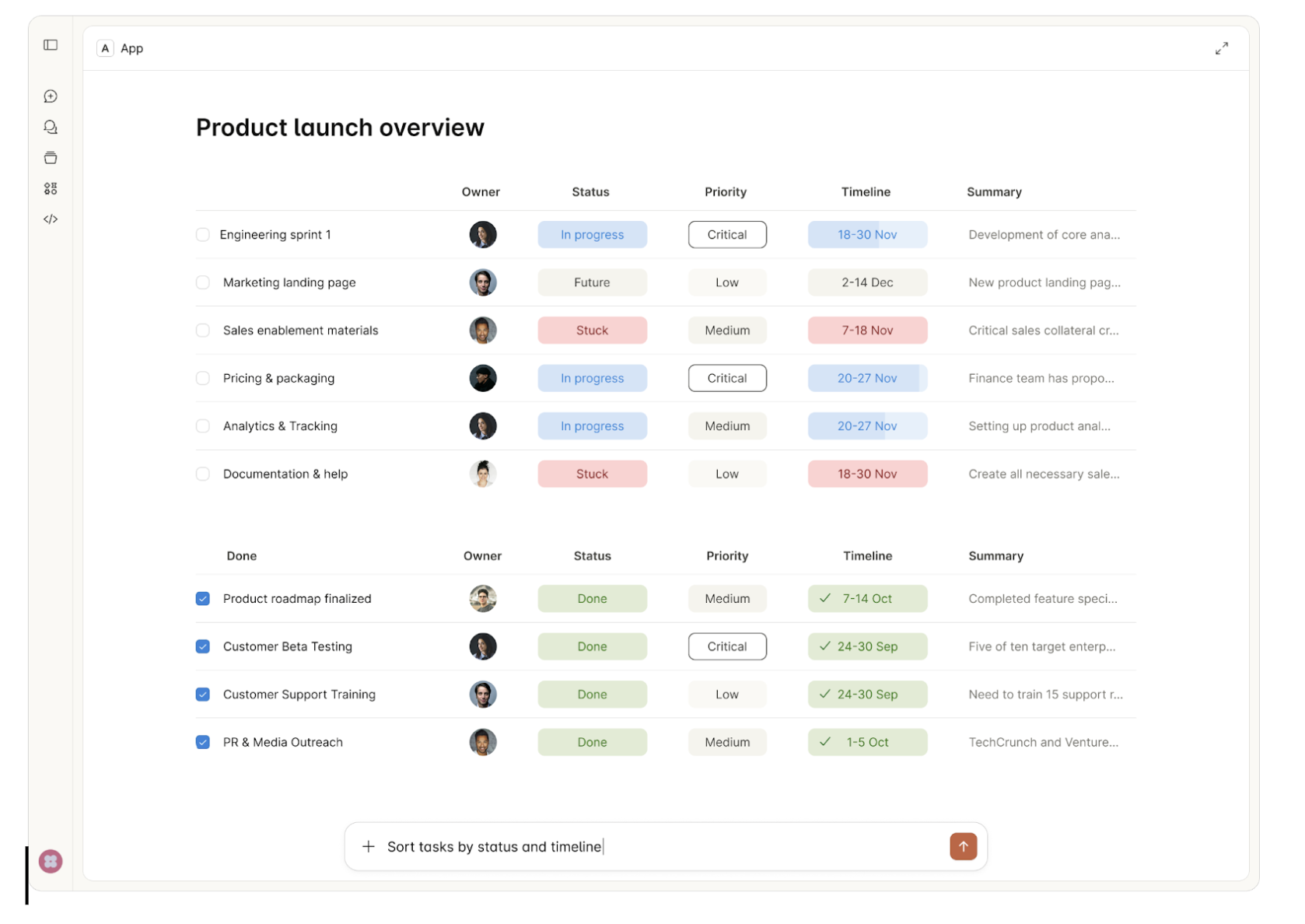
At its heart, Generative UI turns AI into an on-demand designer and developer, moving us from fixed apps to intent-driven, adaptive experiences.
How: Practical Use Cases and Current Examples
Generative UIs are already live in 2025 products, built via tool-calling workflows where LLMs decide on actions and render outputs.
Core Implementation: Developers define tools (functions for tasks like weather lookup) and map results to UI components. In Vercel's AI SDK, a prompt triggers tool execution, streaming results to custom React elements like weather cards.
Real-World Examples Today:
Google Gemini App and Search: Ask "Compare mortgage options," and Gemini 3 generates an interactive calculator with sliders for rates and terms. For education, prompts like "Explain RNA polymerase" yield custom simulations with controls.
Data Visualization: In AI Mode, queries produce tailored charts, grids, or maps, outperforming static responses.
Personalized Tools: Gemini creates custom event planners or learning games, adapting complexity (e.g., simple for kids, detailed for experts).
Developer Tools: Google's A2UI protocol (launched December 2025) standardizes agent-generated interfaces, integrable with frameworks like React or Flutter for enterprise workflows.
Chat Enhancements: Using AI SDK patterns, apps render stock tickers, calendars, or forms directly in conversations.
These examples show Generative UIs making interactions more intuitive, reducing text overload with visuals and controls.
Why: The Importance and Outlook for 2026
Generative UIs are pivotal because they solve the limitations of text-heavy AI, delivering personalized, efficient experiences that feel truly native. Human evaluations show strong preferences for these dynamic interfaces over standard outputs, boosting engagement and accessibility.
Their importance lies in:
Hyper-Personalization: Interfaces adapt to user expertise, device, or context, making tech inclusive.
Developer Efficiency: Shift focus from coding fixed layouts to defining intents and tools, accelerating app creation.
Agentic Future: With protocols like A2UI and MCP extensions, AI agents will embed rich UIs seamlessly, powering multi-agent systems.
Looking to 2026: Expect widespread adoption, with automatic UI generation (no manual toggles), deeper integration across apps, and multimodal enhancements (voice, AR). Enterprises will deploy agent-driven dashboards, while consumers get "just-in-time" apps replacing static ones. Challenges like speed and consistency will improve, making Generative UIs the default for AI interactions.
This technology isn't optional—it's the bridge to an adaptive, human-centric digital world.
Sources