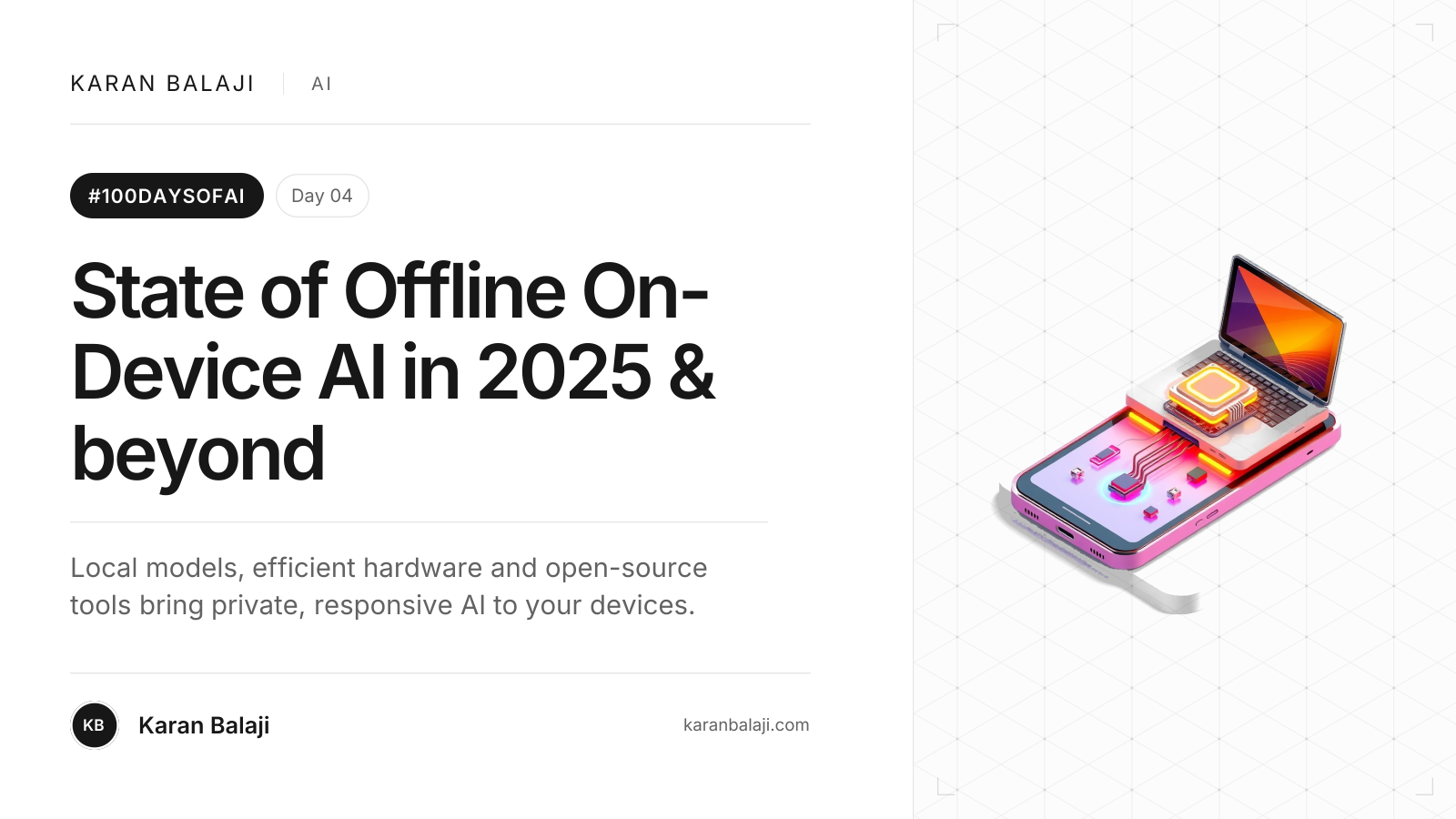
Day 4/100: State of Offline On-Device AI in 2025 & beyond
Local models, efficient hardware and open-source tools bring private, responsive AI to your devices.
Day 4/100: Intro to Offline On-Device AI
What is Offline On-Device AI?
Offline on-device AI refers to artificial intelligence systems that run entirely on local hardware, such as smartphones, laptops, or edge devices, without needing an internet connection or cloud servers. This approach processes data and generates outputs directly on the device, emphasizing privacy, low latency, and reliability. By the end of 2025, on-device AI has matured significantly, driven by advancements in hardware like neural processing units (NPUs) and efficient models tailored for constrained environments. Models now handle complex tasks like multimodal processing, which requires substantial memory but operates within device limits, often around 6GB peak usage.
The current state as of late 2025 shows widespread adoption across industries. For instance, AI models like Llama 3.1 70B serve as generalist benchmarks, while specialized ones like DeepSeek R1 enable advanced reasoning on smaller devices. Companies such as Apple, Google, and Qualcomm have optimized runtimes, allowing GPT-style models to run locally on everyday hardware. Offline AI chat apps are booming in sectors like tourism and e-commerce, where models like Gemini Nano manage 1.5 billion parameters for seamless interactions in low-connectivity areas. New devices, such as Holiverse's offline AI hardware, embed private AI to keep data control with users, eliminating external server dependencies.
Looking ahead, the future of offline on-device AI points to hybrid systems by 2026 and beyond, blending local and cloud processing for optimal performance. Trends include context-aware AI in wearables and earbuds, enabling always-on intelligence with offline reliability. Mobile apps will shift more processing to the edge, reducing latency and enhancing privacy, with projections that 90% of new apps will incorporate on-device AI capabilities. An "offline renaissance" may emerge, prioritizing local compute amid declining social media usage and rising voice-first tech.
The State of Offline AI in 2025
As of end-2025, offline AI is underserved yet scaling rapidly, with the global AI market projected to grow from USD 233.46 billion in 2024. Challenges include hardware-software gaps, where models grow faster than device capabilities, but solutions like NPUs in laptops address this by enabling local runs of large language models (LLMs). Decentralized infrastructure and open-source fine-tuning are key trends, fostering specialized models for edge use.
The Open-Source Framework Stack for On-Device AI
Open-source frameworks form the backbone of on-device AI development. TensorFlow Lite and PyTorch Mobile lead for mobile inference, while ONNX Runtime ensures model portability across devices. Other notables include Hugging Face Transformers for model access, Scikit-learn for lightweight ML, and specialized tools like NNStreamer and NNTrainer for on-device learning and reasoning. Repositories like Awesome LLMs on Device curate resources for running large models locally. Emerging frameworks like DroidRun enable AI agents on Android, automating workflows directly on hardware.
The Offline On-Device AI Ecosystem Explained
The ecosystem spans compilers, runtimes, optimization tools, and local servers, creating a full pipeline for efficient edge AI.
Compilers in On-Device AI
Tools like ML compilers optimize models for edge deployment, making them faster and more secure. Techniques include operation fusion to combine operations, reducing memory use.
Runtimes for Efficient Inference
Frameworks such as TensorFlow Lite or ONNX Runtime handle inference on devices, supporting quantization for smaller footprints.
Optimization Techniques
Methods like pruning (removing unnecessary parameters) and quantization (reducing precision) enable models to fit on limited hardware. Samsung's optimizations allow large AI models to run efficiently on-device.
Local Servers for Privacy-Focused AI
Tools for serving models locally, such as Ollama or ML Drift, facilitate GPU-accelerated inference without cloud reliance, ideal for privacy-focused applications.
Google's Coral NPU: A Full-Stack Open-Source Platform for Edge AI
Google's Coral NPU, launched in October 2025, is a groundbreaking full-stack, open-source platform designed to tackle performance, fragmentation, and privacy issues in edge AI, particularly for low-power devices and wearables. It enables always-on AI by embedding intelligence directly into personal devices, ensuring data privacy and operational efficiency.
Key Features and Architecture
The Coral NPU features an AI-first architecture built on RISC-V ISA-compliant IP blocks, including a scalar core for lightweight C-programmable tasks, a vector execution unit for SIMD operations compliant with RISC-V Vector v1.0, and a matrix execution unit for quantized neural network computations. This design prioritizes the ML matrix engine over traditional scalar compute, optimizing for machine learning workloads. It delivers 512 GOPS of performance while consuming just a few milliwatts, making it ideal for battery-constrained devices like smartwatches and AR glasses.
Open-Source Aspects and Availability
Fully open and extensible, the platform includes documentation and tools available at developers.google.com/coral, with the matrix core set for GitHub release later in 2025. It supports open standards and collaborations, such as with Synaptics on their Torq NPU subsystem.
Integration and Software Stack
Coral NPU integrates seamlessly with compilers like IREE and TFLM, and frameworks including TensorFlow, JAX, and PyTorch. The software toolchain features an MLIR compiler, custom kernels, and a simulator, processing models through StableHLO for optimized binaries. In the broader ecosystem, it acts as a hardware-software bridge, enhancing runtimes and optimizations for IoT and wearables, accelerating applications like ambient sensing, audio processing, and gesture control.
Partnerships and Edge AI Support
Co-developed with Google Research and DeepMind, it partners with Synaptics for production in Astra SL2610 processors. It supports hardware-enforced privacy via CHERI and targets complex models like small transformers, bringing LLMs to edge devices.
How to Implement Offline On-Device AI
Implementation starts with selecting frameworks and optimizing models for target hardware.
Practical Examples and Use Cases
Mobile App Integration Example
Use TensorFlow Lite to deploy a model for offline image recognition. Download a pre-trained model from Hugging Face, quantize it, and integrate via code:
import tensorflow as tf

# Load quantized model
interpreter = tf.lite.Interpreter(model_path="model.tflite")
interpreter.allocate_tensors()

# Run inference on input data
input_details = interpreter.get_input_details()
output_details = interpreter.get_output_details()
interpreter.set_tensor(input_details[0]['index'], input_data)
interpreter.invoke()
output = interpreter.get_tensor(output_details[0]['index'])
This enables real-time object detection on smartphones, useful for augmented reality apps.
IoT Device Setup with Coral NPU
With Coral NPU, compile a model using its tools for edge deployment. For a smart camera, optimize for low power and run inference locally, processing video feeds without cloud uploads. Use case: Security systems in remote areas.
Hybrid Workflow Example
Train in the cloud, then deploy on-device via ONNX. Optimize with pruning tools to reduce size by 50%, enabling offline chatbots for e-commerce in spotty networks.
Tools like Apple's MLX framework support distributed workloads on M-series chips, ideal for clustering devices like Mac Minis for local AI farms.
Why Offline On-Device AI is Important
Offline on-device AI is crucial for privacy, as data never leaves the device, reducing risks of breaches. It cuts latency for real-time applications like autonomous agents and enhances reliability in offline scenarios. Economically, it lowers costs by avoiding cloud fees, and environmentally, it promotes efficient compute. As AI commoditizes, on-device focus, like Apple's strategy, positions it as a competitive edge in a hybrid future.
Sources:
https://www.f22labs.com/blogs/what-is-on-device-ai-a-complete-guide/
https://etcjournal.com/2025/10/25/five-emerging-ai-trends-in-late-october-2025/
https://tech.yahoo.com/ai/articles/state-ai-2025-google-apple-154700222.html
https://medium.com/design-bootcamp/on-device-ai-ux-in-2025-ship-an-honest-hybrid-8e450ca7fd4d
https://www.digitalbricks.ai/blog-posts/ai-progress-in-2025-whats-happened-and-whats-next
https://siliconsandstudio.substack.com/p/tech-extra-ai-predictions-for-2026
https://aiwithallie.beehiiv.com/p/my-2026-ai-predictions-and-the-three-things-you-need-to-focus-on
https://www.dotcominfoway.com/blog/mobile-app-development-trends-2026-on-device-ai-edge-and-beyond/
https://www.novusasi.com/blog/the-rise-of-local-ai-models-going-small-to-go-big
https://www.digitalocean.com/resources/articles/open-source-ai-platforms
https://www.atlantic.net/gpu-server-hosting/top-open-source-ai-ml-frameworks-in-2025/
https://www.reddit.com/r/opensource/comments/1m6btnb/we_just_opensourced_the_first_mobile_ai_agent/
https://www.instaclustr.com/education/open-source-ai/top-10-open-source-llms-for-2025/
https://anshadameenza.com/blog/technology/2025-12-08-on-device-hybrid-architectures-edge-ai/
https://valerelabs.medium.com/edge-ai-the-rise-of-on-device-ai-8e6348bea620
https://latentai.com/blog/ai-model-compilation-for-high-performance-models-at-the-edge/
https://www.mobilint.com/post/how-local-llms-transform-ai-strategy
https://harvard-edge.github.io/cs249r_book/contents/core/frameworks/frameworks.html
https://www.interactivesilicon.ai/news/ml-drift-on-device-generative-ai-impact-and-adoption/
https://developers.googleblog.com/introducing-coral-npu-a-full-stack-platform-for-edge-ai/
https://www.linkedin.com/pulse/coral-npu-full-stack-platform-edge-ai-billy-rutledge-dfwkc
https://www.infoq.com/news/2025/10/google-coral-npu-platform/
https://howaiworks.ai/blog/google-coral-npu-announcement-2025
https://www.cnx-software.com/2025/10/17/google-open-source-coral-npu-synaptics-sl2610-edge-ai-socs/
https://developers.googleblog.com/en/introducing-coral-npu-a-full-stack-platform-for-edge-ai/