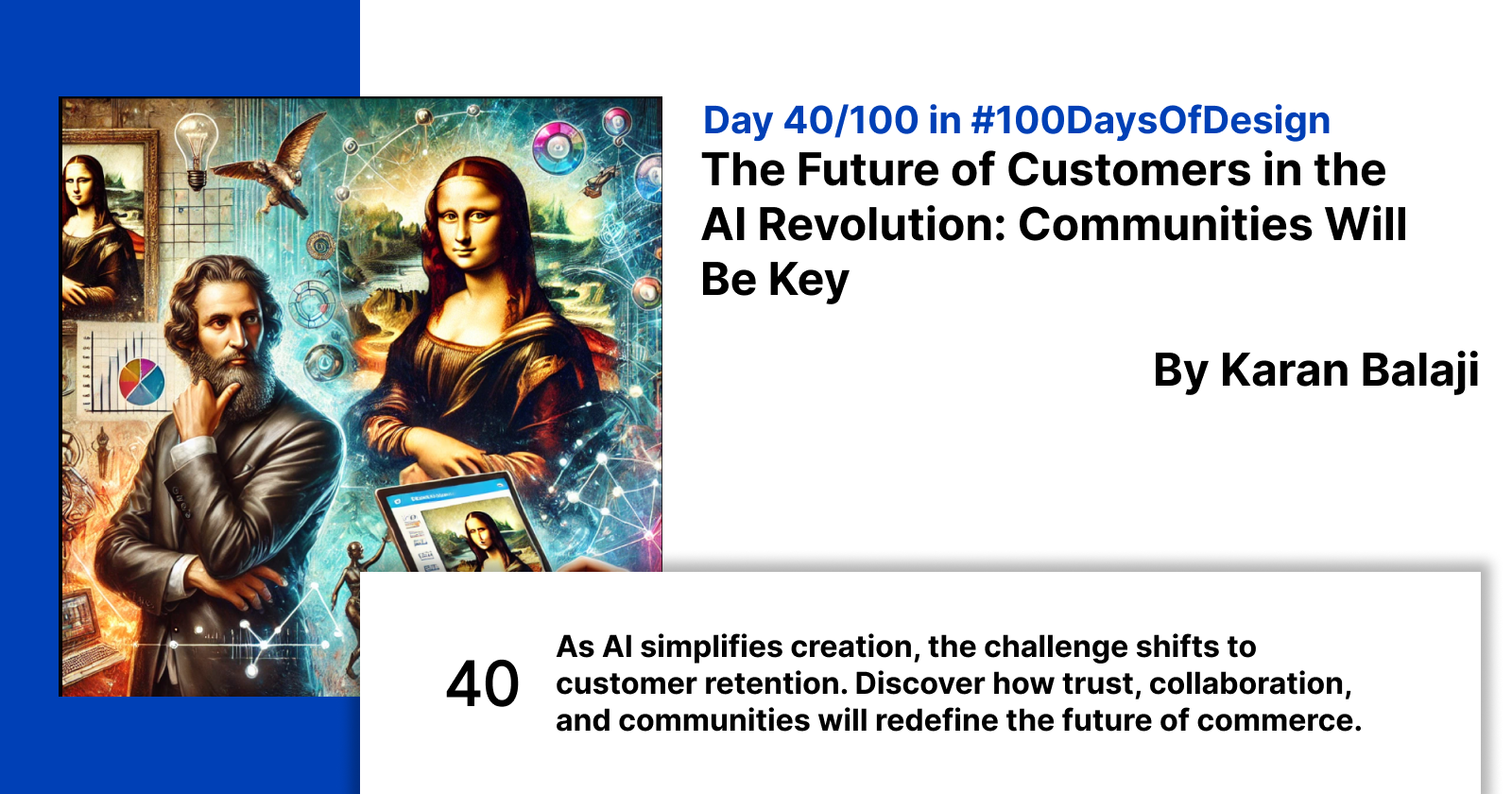
Day 40/100: The Future of Customers in the AI Revolution: Communities Will Be Key
What is Changing? As AI continues to evolve, it’s making the process of creating products more accessible than ever. Today, with just an idea and the right tools, anyone can innovate and bring something to life. However, this newfound simplicity is s...
What is Changing?
As AI continues to evolve, it’s making the process of creating products more accessible than ever. Today, with just an idea and the right tools, anyone can innovate and bring something to life. However, this newfound simplicity is shifting the challenge from how to create to how to acquire and retain customers. With the market flooded with similar offerings, standing out becomes the ultimate test—and communities might be the answer.
Why Communities Matter: Decentralizing Monopolies and Power
Trust Drives Consumer Choices
One of the most influential factors in consumer decision-making is trust. People don’t just buy products; they buy into the individuals and brands behind them. Communities foster this trust through shared values, experiences, and open dialogue. When customers feel connected to a creator or brand, they’re more likely to support it—and stay loyal.
Take the example of potato chips:
Imagine choosing between five nearly identical brands in a supermarket. Now imagine a friend or community member introduces a healthier, equally tasty, and slightly innovative option. You’d likely pick their product—not just because it’s better, but because you trust the person behind it. And if the product falls short, you’d feel empowered to give honest feedback, knowing it would be acted upon.
Faster Feedback Loops
Communities enable creators to receive direct, real-time feedback, unlike traditional businesses relying on slow surveys or impersonal market research. This creates a fast feedback loop, allowing products to be continuously refined.
For instance, if your friend’s potato chips were too salty, you could immediately let them know. They might tweak the recipe based on your input, improving the product while strengthening your trust in their responsiveness.
Emotional Differentiation
In an age of commoditization, products alone won’t set businesses apart. Emotional and social connections created through communities will be the true differentiators. Platforms like Patreon, Substack, and Heylo already show how community-driven models flourish. Consumers are willing to pay a premium for products and services that align with their values and offer a deeper connection.
Applying Nash Equilibrium to Communities
Removing Abuse and Power Imbalances
The Nash Equilibrium, a principle from game theory, describes a state where no participant can benefit by unilaterally changing their strategy. This concept can apply to communities, ensuring fairness and reducing abuse.
Case Study: Midnight Runners
Two years ago, I joined Midnight Runners Toronto when it was a small group of 50 runners. Documenting its journey through Instagram reels created organic virality, growing its following to over 20,000. However, as it scaled, challenges emerged. Negative behaviors by certain leaders and members began to damage the community’s reputation.
The Hype Squad Effect
To counteract these dynamics, I formed the "Hype Squad," a group of 80+ members chosen not by status but by how they treated others. This diverse group—from top entrepreneurs to individuals known for kindness—helped shift the culture. We hosted potlucks, karaoke nights, and genuine celebrations, prioritizing shared experiences over hierarchy.
How Can Creators Leverage Communities?
Start Small, Build Trust: Foster a tight-knit group of early adopters and engage authentically.
Create a Feedback Loop: Act on feedback to show customers their voices matter.
Highlight Shared Values: Build narratives around shared goals and missions.
Measure Loyalty, Not Just Growth: Focus on retention and satisfaction over numbers.
Use Tools Effectively: Leverage platforms like Heylo, Patreon, or Discord for engagement and tools like Hotjar and Google Analytics for product insights.
Challenges of the Community-First Approach
Scalability: Keeping intimacy alive as communities grow is difficult.
Transparency: Higher accountability demands openness.
Competition: Differentiating yourself in a community-driven market requires creativity.
Thriving in the Age of Digital Accountability
Key Insight for Creators and Future Businesses:
"The power of communities lies in trust, collaboration, and distribution—not monopolies."
The Role of AI in Accountability
AI acts as both a tool for creators and a watchdog for humanity. It ensures transparency by sifting through data to surface truths, making it harder for businesses to obscure their actions. This transparency, however, is an opportunity to leverage AI for continuous improvement and stronger relationships.
Conclusion: The Future is Personal
The future belongs to those who embrace community-driven models. By prioritizing trust, collaboration, and shared ownership, businesses can thrive—not by dominating markets, but by creating ecosystems where everyone succeeds together.
References
DataReportal. (2024). Digital Around the World. Retrieved fromDatareportal
Oberlo. (2024). How Many People Use the Internet in 2024?. Retrieved fromOberlo
Statista. (2024). Internet and social media users in the world 2024. Retrieved fromStatista
Sutskever, I. (2024). Data Is the 'Fossil Fuel' of A.I.. Retrieved fromObserver
The Verge. (2024). OpenAI cofounder Ilya Sutskever says the way AI is built is about to change. Retrieved fromThe Verge
How to Cite This Article
Balaji, Karan. (2024, December 21). Future of Customers in the AI Revolution: Communities Will Be Key. Retrieved from https://blog.karanbalaji.com/day-40-future-of-customers-in-the-ai-revolution-communities-will-be-key